
Scan & Pay product UX
Creating delightful UX on the Scan & Pay product suite
Overview
As a UX Designer at Lobyco (Coop Denmark), I worked on the Scan & Pay product suite, a self-service solution used by more than one million customers and responsible for over 20% of in-store transactions across Denmark. The work focused on improving an experience spanning mobile apps, in-store systems, and back-office tools, where customer experience, store operations, and fraud prevention had to work together.
Due to confidentiality considerations, this case focuses on overall contributions and selected examples rather than detailed product visuals or specific interface designs.
My roleLed UX design across mobile apps, in-store systems, and back-office tools.PlatformMobile apps (iOS and Android) · Self-checkout kiosks · Web administration toolFocusRetail · Product UX · Service design · Interaction design · Usability testing · Design systemsOutcomeImproved key user flows and introduced new features that reduced friction for customers and employees, supported store operations, and strengthened fraud prevention.Year2020 - 2023
Video source: Lobyco website (2023)
Customer UX:Mobile self-scanning
I continuously worked on improving the end-to-end experience for customers using Scan & Pay on their smartphones, aiming to provide a frictionless shopping experience at their own pace. This involved adapting the service to various shopping behaviors by leveraging insights from user research, user analytics, product discovery, and user testing. Additionally, it required close collaboration with developers and external stakeholders within the Coop Denmark organisation to optimise store operations in support of the service.
Employee UX
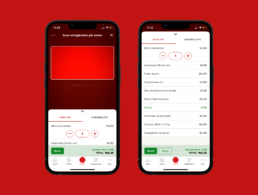
One of my proudest achievements was notably improving the service for Coop store employees who perform rescans, age checks, and other tasks as part of their many daily responsibilities. I played an important role in introducing a new, user-friendly advanced rescan process.
The objective of this project was to enhance fraud prevention more efficiently and thoroughly in the fast-paced store environments. After the full rollout, we evaluated its impact and observed a significant improvement in the service’s security. In addition to maintaining an ambitious UX focus throughout the process, my close collaboration with backend and frontend developers was key to the project’s success. I also continuously developed and maintained the Figma design system for the mobile app.
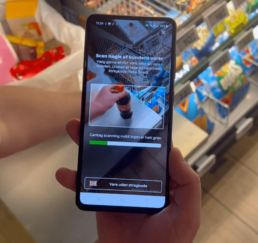
Image source: Lobyco website (similar screen) 2023
Customer UX:Self-checkout kiosk
During my last year in Lobyco, I led the UX efforts on an ambitious project aimed at enabling credit card payments on the self-checkout kiosks. Prior to this, the self-checkouts were only usable in connection with the Coop app that handled payments and digital receipts. The new application should not require a payment terminal, but use NFC to detect credit cards tapped directly on the tablet instead. It should also integrate with a small printer for physical receipts.
Throughout the project, I navigated complex technical challenges, evolving business objectives, and various UX considerations for both customers and employees. This effort also entailed close collaboration with third-party vendors and ongoing stakeholder involvement. In the summer of 2023, the first version of the application went live in a store and is now gradually being released to more stores.
Back office UX:Administrative tool
In addition to my UX focus on our mobile native applications for iOS and Android, I played a key role in creating the white-label web administration tool for the service. This task involved discontinuing several old (and sparsely documented) internal systems in a sustainable manner and unifying key functionality into one white-label application.
I closely collaborated with my two UX student helpers, who assisted in gathering in-depth knowledge of the old systems. I also worked closely with the Coop back office staff who are using these systems, incorporating their input to prioritize features for future use. Through usability testing, staff onboarding sessions, and comprehensive UX documentation, I empowered the back office staff to provide more efficient support for the stores through the application.
Video source: Lobyco website 2023