
Making experts out of beginners
Designing an AI-powered system that guides people with a rare condition through a complex procedure safely
Overview
As an Advanced UX Designer at Novo Nordisk, I helped design an AI-powered product that enables people with a rare condition to perform a complex procedure safely without prior training. The challenge was guiding users through precise movements and device handling without relying on their ability to interpret technical output.
Due to confidentiality considerations, this case uses representative examples and public references to illustrate the challenges, constraints, and design decisions involved.
My roleLed UX and UI across the app, hardware interactions, and in-app instructional materials.PlatformNative mobile app · Connected hardwareFocusHealthcare · AI-guided UX · Interaction design · Usability testing · Instructional design · Design systems · Hardware integrationOutcomeEstablished a clear workflow and guidance approach that improved users’ ability to perform the procedure safely and correctly.Year2024 - 2026
A skill professionals spend years mastering
Ultrasound scanning is a skill that trained professionals spend years developing. It requires precise positioning, controlled movements, and an understanding of how small adjustments affect what can be captured. Even minor changes in angle or placement can determine whether a result is usable.
Here, the challenge was designing for people with no prior experience performing the procedure themselves. They had no trained technique, no established mental model, and no way of interpreting raw output. The design therefore had to support correct performance from the very first attempt.
The target user group was also small and globally distributed due to the rarity of the condition. This limited access to representative users and made each usability session especially important.
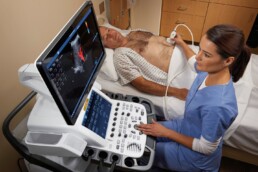
Image source: Northway Clinic – “What an Ultrasound Scan Shows”
Designing for people with no training
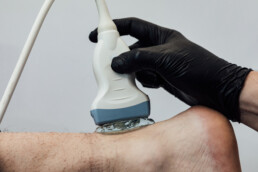
The challenge extended beyond learning a new procedure. Users needed to understand how to position their body, how to hold and move a physical device, and how small adjustments affected the outcome. The task required coordination between human motion, hardware handling, and digital guidance.
The system could not rely on showing captured results to guide users. It was restricted to scanning specific body areas in precise positions, and what the device recorded would not be meaningful without training. Users therefore had to perform the procedure correctly without being able to judge the result themselves.
There were also no established standards for how untrained individuals should carry out this type of procedure on their own. The process had to be defined while it was being designed. Instructions and interaction logic therefore evolved together through repeated testing.
Making experts out of beginners
We designed the solution to guide users step by step through the procedure. Each stage communicated what to do, what state they were in, and what needed adjustment. Structuring the process into clear steps helped users stay oriented and act with confidence.
We translated complex system signals into feedback people could understand instantly. Simple visual cues and familiar metaphors showed whether movements were correct or needed refinement, allowing users to adjust in real time while performing the task.
I contributed across both procedure design and interface design. Together with another designer, a usability engineer, and domain experts, we defined how the procedure should be performed and how the system should guide it. I also co-produced the instructional videos and led the editing, ensuring they were precise, clear, and ready for implementation.
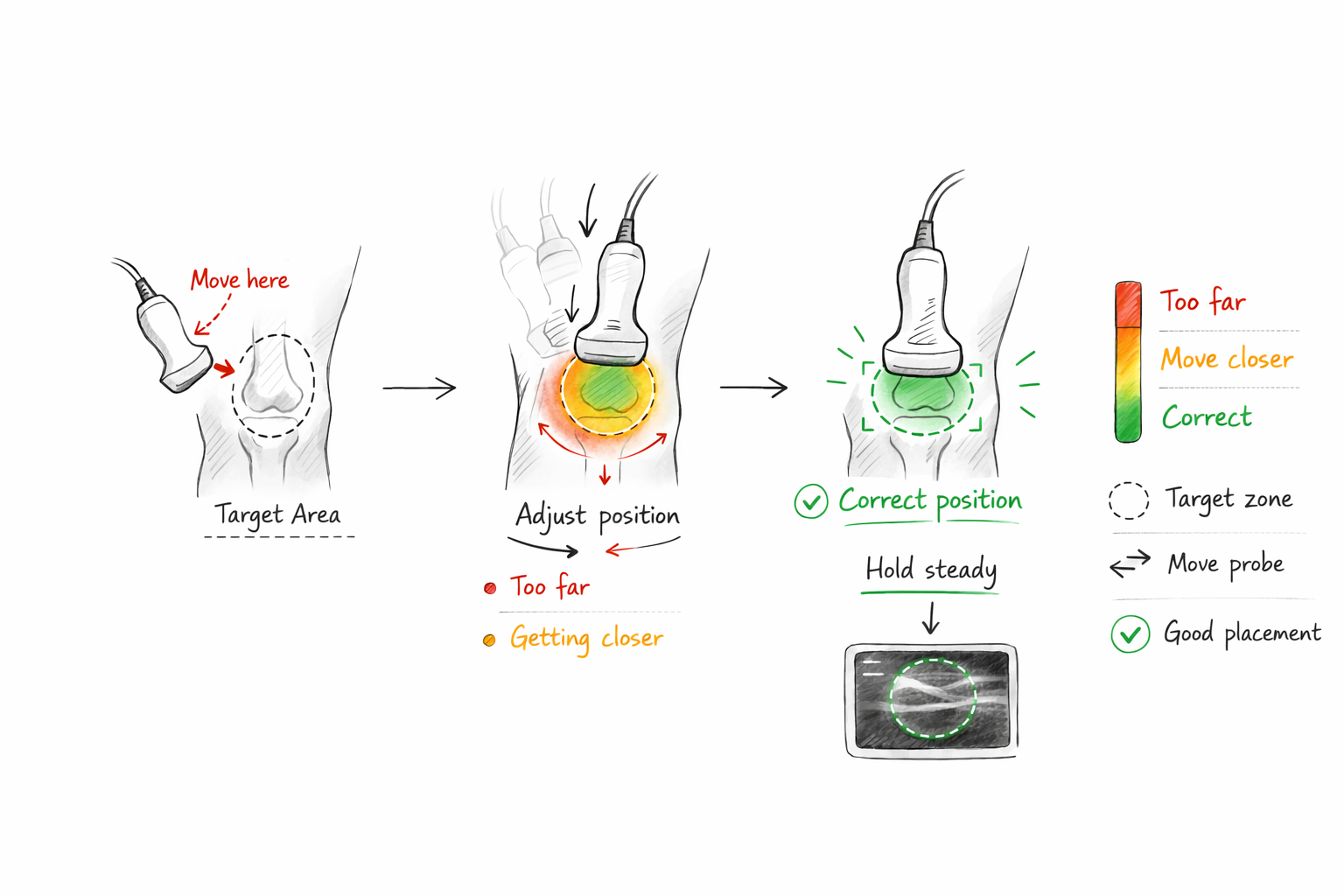
Illustrative concept created for this portfolio case. Not representative of the actual product.
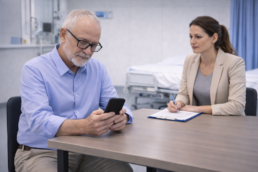
Illustrative image generated specifically for this portfolio case. Not an actual study session.
Putting it to the test
We evaluated the solution across multiple phases to understand whether people could successfully complete the procedure. These sessions covered the full experience: instructions, body positioning, device handling, system feedback, and user confidence throughout the task.
Working with this user group required careful planning. Because the condition is rare, access to representative participants was limited, which made each session especially valuable. Across studies, we involved more than 50 participants, including both proxy users and individuals with relevant experience.
The sessions revealed important friction points. Some participants misunderstood positioning, others misread feedback, and several struggled to recall instructions once they began. We used these findings to refine guidance, adjust interaction flows, and improve instructional materials through repeated iterations, including redesigning parts of the guidance approach late in development.
Nothing about this was simple
This project introduced me to a level of complexity that influenced design decisions at every step. The solution depended on coordination between software, hardware, and an on-device AI model, each with its own constraints. Understanding these factors was essential for shaping how guidance and feedback could work.
Regulatory requirements added another dimension. The experience needed to support safe and correct use, which meant interactions, instructions, and system responses had to be carefully considered and documented. Working in this environment strengthened my ability to design within strict constraints while keeping the experience clear and focused.
The work also required close collaboration across disciplines, including developers, data scientists, domain experts, and compliance specialists. Navigating these perspectives while moving the design forward became a central part of my role.
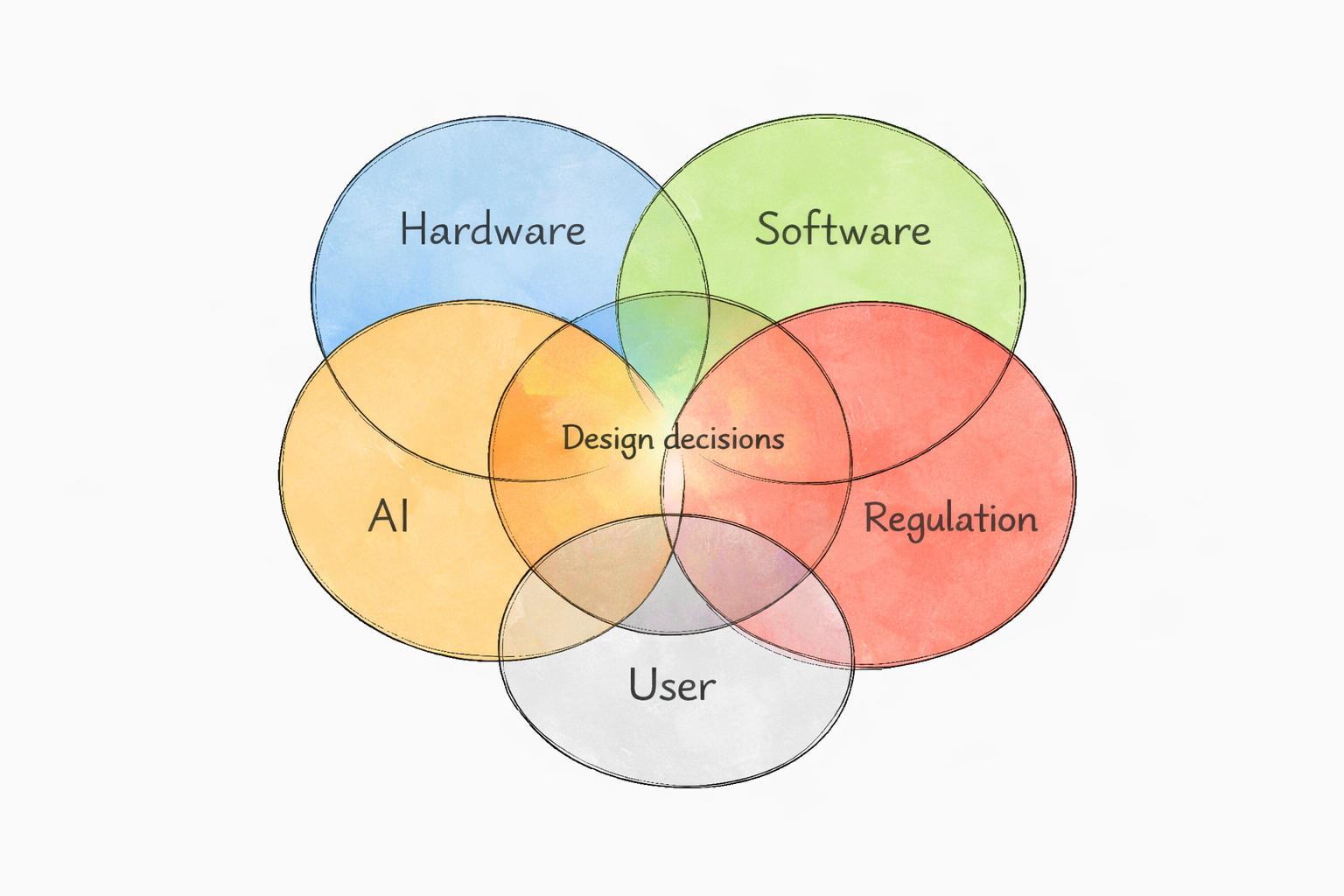
Every design decision had to work across hardware, software, AI behavior, regulation, and human use at the same time.
Value created
My role was to help turn a highly complex concept into something people could actually use. I contributed across interaction design, instructional materials, and workflow definition, helping shape both how the system worked and how users understood it.
By grounding decisions in testing, collaboration, and iterative refinement, I supported the team in moving from early ideas toward a clearer and more workable solution. The work required balancing user needs, technical constraints, and regulatory considerations while keeping the experience understandable and focused.
Overall, my contribution centered on bringing structure, clarity, and momentum to a challenging problem space, helping the team move forward with confidence in both the design direction and the usability of the solution.